Tuesday, 27 October 2009

Audio Journal by MJA Smith : 26/10/2009

Go to: My Other Blog / twitter.com/mjasmith

I have a habit of repeating myself throughout this blog, so apologies for that. One such thing I often find myself saying is how much Robert Fripp redefined the way I listen to guitar music. His Love Cannot Bear: Soundscapes – Live In The USA is a good example of this. Fripp, the backbone of the band King Crimson has, over time, developed techniques that allow his guitar to trigger electronic sounds – often dubbed Frippertronics – from a bank of equipment which fully disguises the fact that a guitar prompted the sound that emerges. The result is a serene suite of electronic atmospherics which allowed me in the past to bridge the gap between the apparently limitless possibilities of the synth and the enduring versatility of the humble electric guitar.
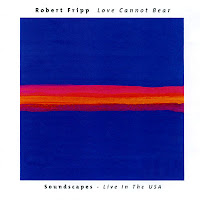
Robert Fripp 'Love Cannot Bear' CD sleeve

Fripp frequently played on records produced by Brian Eno, and the two have collaborated on a number of influential duo albums. Eno’s Desert Island Selection, a companion CD album to the vinyl More Blank Than Frank comprises tracks culled from his back catalogue and sees Eno’s progression from post-Roxy glam oddness on Here Come The Warm Jets to the pioneering ambience of Music For Airports. I already own More Blank Than Frank on vinyl, which I bought many years ago in Barcelona. I’d like to say that I was in the city on some sort of Hemingway-inspired bohemian backpacking expedition, but I wasn’t. Regrettably, whilst there’s a bit of cross-over between the two albums, the best track on More Blank Than Frank – ‘King’s Lead Hat’, an anagram of Talking Heads, who Eno produced – is absent here. ‘I’ll Come Running (To Tie Your Shoe)’ and ‘Here He Comes’, close second and third are here however.

Brian Eno 'Desert Island Selection' CD sleeve

One of the defining artistic collaborations Eno developed was with David Bowie, who began working with the producer when he uprooted to Berlin in the mid-1970s. Low is an album which found Bowie in introspective mode, Eno and others (including Robert Fripp) adding texture and colour on what has become an influential piece in the more experimental territories of Bowie’s back catalogue. Low has a reputation for being bleak and dark (it was a major influence on Joy Division, a band who made the words ‘bleak’ and ‘dark’ very much their own), but I don’t really hear that. The first half is made up of electronically-augmented leftfield pop while the second half is broadly instrumental and more like what you‘d expect from Eno.

David Bowie 'Low' CD sleeve

David Bowie once had a very public spat in a New York restaurant with the imperious erstwhile Velvet Underground singer / guitarist Lou Reed which is well documented in Christopher Sandford’s Loving The Alien biography. Lou Reed and his former Velvets song writing partner John Cale reconciled some of their personal and artistic differences to record Songs For Drella in 1990. ‘Drella’ was a nickname adopted by Andy Warhol, who was by 1990 three years departed of this earth. Warhol, the sui generis poster boy for pop art, was responsible for launching the Velvets into the art and rock world’s conscience, ‘producing’ their debut album in the only way he knew how – by letting the tapes run and just recording whatever racket the band wanted to make, much as with the lo-fi hands-off way in which he produced his videos. The Velvet Underground And Nico was derided at the time by the establishment as being under-produced and, like much of the mainstream art world perception of Warhol’s work at the time, lazily crafted.

That backlash to someone who’s influence has been rewritten and made large over time is a theme that emerges in Songs For Drella. The album is basically a mini-operetta by the two musicians biographically detailing Warhol’s life from his upbringing in blue-collar Pittsburgh, his early employment as an illustrator for a shoe firm, through the speed- and heroin-addled craziness of the Factory, the development of Warhol’s signature repetitive style, his near-fatal shooting by Valerie Solanis, the creative void after and his ultimate corporeal decline. Cale and Reed take it in turns to deliver the songs, including one piece where Cale perfectly apes Warhol’s introspective and scattershot tonality on a piece which sees him read from the artist’s journals, a piece in which he mourns the loss of Factory stalwarts like Billy Name and curses those who he feels have disappointed him, such as Ondine and Reed. Reed responds on the final track ‘Hello It’s Me’ wherein he finally offers a heartfelt apology for neglecting their friendship, reaffirms his love for Warhol’s work, and sticks the boot in with a few feelings that he won’t let lie.

Lou Reed and John Cale 'Songs For Drella' CD sleeve

Reed and Cale both collaborated with Factory girl and Warhol muse Nico on her album Chelsea Girl. Nico possessed a leaden Teutonic intonation which can make listening to her singing somewhat uncomfortable. Me, I’ve gone from detesting the intrusion of her voice on the Velvets’ debut to finding new depths in her style, and so it was with the latter view that I approached Chelsea Girl, the title track of which explores the madness of the Hotel Chelsea wherein she reels off accounts of morally reprehensible behaviour by the Factory cast and crew. (I should at this juncture point out that another album I’ve been listening to over and over this week is Love Is Hell by Ryan Adams, which also includes a song about the Chelsea; more on that album below.) The entire feel of the album has a low-key Greenwich-Village-café-on-a-Sixties-Sunday-afternoon sort of vibe, with lots of flute and strummed acoustic guitars. Occasional strings colour the atmosphere tenderly.
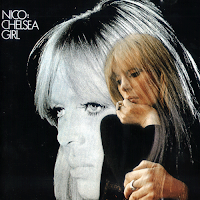
Nico 'Chelsea Girl' CD sleeve

Andy Warhol designed the homoerotic sleeve to The Rolling Stones’s Sticky Fingers, from which the hits ‘Brown Sugar’ and ‘Wild Horses’ were culled. Growing up at a time when the Stones were well past their peak and already on the mega-tour circuit which positioned them as greedy old dudes on a tour bus, I completely overlooked the powerful and sometimes challenging sound they perfected earlier on in their career; so I‘ll readily admit to being late to the party when it comes to albums like Sticky Fingers, where my favourite tracks are those – like the best Velvet Underground tracks – that deal with the darker side of life – ‘Sister Morphine’ is one long homage to chemical dependency while ’Can’t You Hear Me Knocking’ lurches perfectly from bluesy soul-rock to honky-tonk jazz via some Bitches Brew-esque percussion.

The Rolling Stones 'Sticky Fingers' CD sleeve

‘Sister Morphine’ was co-written with Marianne Faithfull, who also provided backing vocals on Ryan Adams’s Love Is Hell. All I will say about Love Is Hell is that very occasionally an album comes along which makes you think to yourself ‘You know what? If I never listened to another album again after this I wouldn’t mind.’ Love Is Hell is one of those albums. It’s moving, uplifting, bleak, disturbing all at once and I can honestly say I’ve heard nothing else like it. I must have listened to it a dozen times and counting and I’ve only owned it for a week.

Ryan Adams 'Love Is Hell' CD sleeve

There will be no Audio Journal next week as I need a break from turning this out each week. Instead I’ll be putting the finishing touches to a piece for My Other Blog about – I kid you not – teenage girls eating Pot Noodles on the train at 8.50 in the morning. Oh, and probably listening to Love Is Hell over and over.

Follow me on Twitter.

Monday, 19 October 2009

Audio Journal by MJA Smith : 19/10/2009

Go to: My Other Blog / twitter.com/mjasmith

Though perhaps not as radical or aurally challenging as some of their earliest work, Einstürzende Neubauten’s Ende Neu (1996) still finds the Berliners hammering away at steel, deploying compressors and all manner of junkyard mechanics to produce their highly individual artistic sound. Frontman, vocalist and guitarist Blixa Bargeld, more recently departed of Nick Cave’s Bad Seeds, holds the lot together with vocal deliveries that transcend the German language’s supposed lyrical limitations, and on the highly un-Neubuaten string-soaked tracks with Meret Becker, shows that the gradual progression of Nick Cave’s writing while Bargeld was on board – from Old Testament fervour to romantic wonder – was not wasted on Blixa‘s own writing. Nevertheless, despite those stretching tracks, my favourite tracks are ‘Installation No.1’, with its vocal of ‘Disobey / It’s a law’ and the frantic, dystopian opener ‘Was Ist Ist’.

Neubauten 'Ende Neu' CD sleeve

When I was a subscriber to The Wire magazine – a music magazine, not a monthly publication based on the cult US TV crime drama – they would rave about the elusive, illusory character Jandek, a prolific artist reclusively skulking on the fringes of alternative music. His music was always on my list to sample at some point, but I simply never got around to it. This week, UbuWeb, the go-to site for all things alternative, sent round a link to a blog containing 31 Jandek albums, from the early 1980s through to Skirting The Edge, released this year on Jandek’s own Corwood Industries label. I figured the latter would be a suitable entry point to his music. Essentially, Skirting The Edge is four tracks of vocal musings over incandescent acoustic guitar, with a bleak tone throughout. ITunes labelled it as ‘lo fi’ when I added it to my library, which is probably right, given its raw production aesthetic.

Jandek 'Skirting The Edge' CD sleeve

On to slightly more accessible things, this week I downloaded the eponymous debut from The Little Death, or, more appropriately, The Little Death (NYC) as there are apparently two bands with that name in existence. It’s tempting to describe the band as Moby’s low key side-project, as he is indeed a core member, providing guitars across their debut album. In truth, The Little Death is principally a vehicle for vocalist Laura Dawn, who has appeared live with Moby and contributed vocals to at least one of his albums. The overall sound is one of soulful blues, as filtered through a bunch of musicians living in New York. Gutsy female vocalists aren’t ordinarily my thing, but on this album I’ve found it pretty engaging. My favourite songs are the upbeat tracks ‘Mean Woman’, ‘Hurricane’ and ‘Love Or A Gun’.

From the blues I moved effortlessly to ambient electronica, as crafted by Sheffield’s Richard H. Kirk, founder member of Cabaret Voltaire, one of the bands – like Neubauten – who were grouped together under the banner ‘industrial’. Virtual State (1993) was released on Warp Records and contains lots of trademark Kirk elements – burbling synths, African percussion and distorted samples of speech covertly culled from radio frequencies. This was an album I used to stick on whilst at university to aid concentration while doing my coursework, and consequently hearing it again this week left me feeling rather queasy as I recollected hours spent poring over balance sheets and econometric calculations.

Richard H. Kirk 'Virtual State' CD sleeve

In response to the BBC’s Synth Britannia documentary, it would be all too easy at this juncture to prattle on about all the bands that I like from the synth-pop era, but I won’t. I was castigated by a reader a couple of weeks back for the admission that Erasure remain my favourite band, so let’s not even go there. Instead, in deference to the influence of the humble synth on popular music, I’ll mention a single released about fifteen years ago by Node – U2 / Depeche Mode / PJ Harvey producer Flood and Suede producer Ed Buller and a couple of others – called ’Terminus’ which saw the duo setting up massive modular synths on the concourse of Paddington Station. One can only imagine the reaction of travellers heading to the South West upon hearing the sounds the duo coaxed from their monolithic walls of dials, switches and cabling, but no doubt it was as similarly divisive as when Kraftwerk’s ‘The Model’ first graced the charts.

Node 'Terminus' CD sleeve

Follow me on Twitter.

Monday, 12 October 2009

Audio Journal by MJA Smith : 12/10/2009

Go to: My Other Blog / twitter.com/mjasmith

Last week was spent listening – mostly – to music that prompts recollections of events, people and situations.

The first was Possessed by the Balanescu Quartet. Possessed is effectively a collection of classical arrangements of Kraftwerk songs – ‘The Robots’, ‘The Model’, ‘Autobahn’ – and a handful of other arrangements, including ‘Hanging Upside-Down’ by David Byrne.


Balanescu Quartet 'Possessed' CD sleeve

I saw the Balanescu Quartet perform live at the Patti Smith-curated Jimi Hendrix tribute, the last event to take place at the Royal Festival Hall on London’s South Bank before it closed for a swanky refit. They performed four classical adaptations of Hendrix tracks, their version of ‘Foxy Lady’ being the best of the bunch; they certainly providing an accessible counterpoint to other acts on the bill, chiefly Red Hot Chili Pepper bassist Flea who provided ten minutes of looping bass and trumpet that bore little relation to any of the Hendrix back catalogue.

Alexander Balanescu is not simply known for these arrangements of music from other genres; he is an accomplished composer whose scores have adorned film and television soundtracks, but Possessed is what it is – an accessible classical album, but one that fans of Kraftwerk can listen to comfortably, hearing the tracks almost as remixes rather than re-arrangements.

This album has a tragic poignancy for me. The first time I listened to this album was on the Underground. I was stuck on a train a few feet below the streets around Kings Cross, having just left the bright platforms of the Tube station. The train stopped and just sat there, sporadic announcements from the driver that we’d be sat there for a few minutes more and that we’d be on the move very soon.

Me, I couldn’t have cared less. I was enjoying the album and the delay simply meant that I’d be late for work, which at the time was no bad thing. In the end, the train pulled forward to a disused platform beneath Pentonville Road, whereupon we were evacuated up into the bright lights of the early morning. It was only at this point that the chaos, panic and devastation of that day, 7 July 2005, became evident. The album played on in my ears but I just wasn’t listening to it anymore.

Listening to Possessed this week was the first time I’ve attempted to listen to it since that day.

Another album prompting memories to resurface is Warp Record’s Artificial Intelligence II collection of ‘ambient’ electronica from the likes of Autechre, Cabaret Voltaire’s Richard H. Kirk, Speedy J and Link. It was the summer 1994 and I’d just been unceremoniously and unexpectedly dumped by a girl. I spent the afternoon laid up on my parents’ sofa listening, initially, to the Depeche Mode song ‘The Things You Said’ on repeat, the accusatory disappointment of that song perfectly matching my despondency. After ten or twelve listens I decided to put something else on; it was a close call between the embittered rage of Nine Inch Nail’s The Downward Spiral or the much more chilled Artificial Intelligence II compilation. The latter won the afternoon, leading me to a more logical and calm state of mind.

Warp Records 'Artificial Intelligence II' CD sleeve

While we’re heading down musical memory lane, I downloaded Radio Musicola by Nik Kershaw this week, the Eighties doyen’s third album. I bought this on cassette from Cash Converters in Colchester in 1997, the day after my first Valentine’s Day ‘with’ my ex-girlfriend. For some reason, we’d decided to spend the evening apart. So I went out into Colchester with my housemates, drank too many Moscow Mules and, well, it didn’t end terribly advantageously. The next day, bleary-eyed, my friend Neil and I went into town late in the afternoon and bought a load of second hand tapes from Cash Converters, one of which was Radio Musicola. While not as good as Kershaw’s first two albums, it nevertheless remains a pop gem. But it definitely sounds better when you’re not hungover.

Nik Kershaw 'Radio Musicola' CD sleeve

Some other things on my iPod this week – ‘Horchata’, the new song by Vampire Weekend which they have punted for free this week (verdict : more of the same, only with bigger production and strings); In Rainbows by Radiohead (not a fan of the band per se, and I’m glad I only paid a couple of quid for this when it was made available as a ‘pay what you like’ download, but it is good); and Howyoudoin? by dub-influenced Sarf Londoners Renegade Soundwave. I don’t know why, but I stuck that last album on my dad’s car stereo one Saturday afternoon on the way to pick up my mother and sister. He balked at the messy, sample-heavy songs, but I insisted on listening to it. He turned to me when we were sat waiting at a red light and said ‘I don’t think your mum would like this,’ as the apocalyptic bad-drug-experience (but never exactly precautionary) account detailed on ‘Blast ‘Em Out’ started its slow and edgy journey out of the speakers.


Follow me on Twitter.

Monday, 5 October 2009

Audio Journal by MJA Smith : 05/10/2009

Go to: My Other Blog / twitter.com/mjasmith

I would describe my approach to music this past week as ‘restless’. I haven’t been able to listen to one band or style of music for very long, which has created a rather odd, disjointed play list for the week.

I started the week listening to some ‘arty’ music, namely The Knee Plays by David Byrne, musical compositions – principally for horns – written for a play by Robert Wilson in 1984. It wasn’t at all what I expected, but then again I’m coming to be continually surprised by Byrne’s eclectic output. Broadly instrumental like last year’s Big Love: Hymnal album, the brass instruments are occasionally complemented by Byrne reading in a flat, robotic monotone. From The Knee Plays I moved on to some Philip Glass violin pieces, driven by an ambition to listen to more of his works after immersing myself in his Low Symphony last week.

David Byrne 'The Knee Plays' CD sleeve

I stumbled upon my Inspiral Carpets album collection this past week. The Carpets, now seemingly permanently defunct, produced four albums of spiky organ-embellished indie pop that transcended the rest of the overrated ‘Madchester’ scene that sprang up in the late 1980s. Whereas at the time their quirky, pseudo-Animals type sound earned them a reputation as oddball leftfielders, with time their songs are found to have an earnestness and depth which few would have bothered to have noticed at the time. The track ‘Two Worlds Collide’ from Revenge Of The Goldfish, with its world-weary chorus of ‘What have I done with my life?’ remains my favourite Inspirals track.

I also listened to a Luke Slater DJ mix on the train home one night while frantically sending emails from my BlackBerry that had two effects – firstly, and positively, the music made me type faster and secondly, I was left feeling light-headed like I’d drunk way too much coffee.

As I write this I’m listening to One Of Our Girls (Has Gone Missing) by A.C. Marias, aka Angela Conway with production assistance from Wire’s Bruce Gilbert among others. Conway now makes films, which is a shame, as this single album from 1991 has an ethereal vocal quality while arch-sound smith Gilbert (who is, along with Sonic Youth’s Thurston Moore and Robert Fripp entirely responsible for redefining how I listen to guitar music) adds obscure textural backdrops. I always think of the song ‘There’s A Scent Of Rain In The Air’ whenever I smell that freshness that prefaces a downpour. More on this album at my Documentary Evidence site.


A.C.Marias 'One Of Our Girls' CD sleeve

Elsewhere, I watched the BBC Imagine documentary on Rufus Wainwright’s first opera which had Wainwright play a new piano song, ‘Zebulon’. Effectively a conversation after many years with an imaginary childhood friend and confidante, the track has a plangent Rufus expressing his sadness at his mother’s illness, and points to a more sorrowful sound on his next album. Rarely, I also found myself listening to Gideon Coe on 6Music, who played a Peel session by Glaxo Babies, a band I’ve never heard of. Their session version of ‘Who Killed Bruce Lee?’ is a Gang Of Four-esque number which was adorned by seemingly random, skronking, James Chance-style saxophone, an element missing from the vaguely inferior studio version. Speaking of sprawling music, I listened to Locust Abortion Technician by Butthole Surfers, one of the more challenging bands on the SSR label to emerge from the States in the 1980s.

Butthole Surfers 'Locust Abortion Technician' CD sleeve

Finally, They Might Be Giants, that quirky pop duo who scored an unlikely hit in the shape of ‘Birdhouse In Your Soul’ in 1990. Since then I’ve always had the band on my list of acts I’d like to listen to more of, though so far this has only extended to the aforementioned song, ‘Istanbul (Not Constantinople)’ and the delicate postcard pop of ‘New York City’, a love song which also lists all the major well-heeled landmarks of Manhattan. So, I was pleasantly surprised a few weekends back, watching Mickey Mouse Clubhouse on Playhouse Disney with my two daughters, to find that TMBG had done both the title music and the song ‘Hot Dog!’ (see video below, or for those reading this on email, click here). So, er, ostensibly for the girls, I downloaded ‘Hot Dog!’ this week and have no qualms in saying that it is a delightfully infectious little song that worms its way, like all the best kids’ songs, into your brain and refuses to budge. Not that I would, for example, listen to it on the train into work. Never. Honest.


Follow me on Twitter.

Monday, 28 September 2009

Audio Journal by MJA Smith : 28/09/2009

Go to: My Other Blog / twitter.com/mjasmith

Only those emerging from solitary confinement would have failed to notice that The Beatles have had their back catalogue repackaged, remastered and re-released, forty years on from their swansong Abbey Road. In our house we’ve watched three anodyne documentaries on the BBC and have very rapidly got sick and tired of walking into pretty much any shop only to have huge cardboard displays containing the remastered digi-pack albums foisted upon us.

Not only that, but we have the albums – in their last remastered guise – in the house already, relics from the days when my wife and her three closest friends were mad keen on the band as teenagers. We’ve found ourselves asking what the point of a remaster actually is when the material is that old. Surely the nature of recording methods back then means there comes a point where the only way you could improve the sound would be to record the instruments again using modern technology?

Nonetheless, in deference, we decided to have a Beatles-only Sunday and spent the day listening to their back catalogue of 200-odd songs on random play. In doing so, we came to the inevitable and well-trodden conclusion that the John Lennon-penned numbers were always the best. Our kids think the comedy Ringo numbers and the goofy Paul McCartney compositions are the best. We can only hope that they grow out of this and see sense in time.

I mentioned a number of blogs ago that I’d been working my way through a number of boxes of old CDs which have permanent and unfortunate residence in my loft. Returning the box I’ve been working through – which contained mostly dance music and industrial albums – I brought down the next one and alighted upon a copy of minimalist composer Philip Glass’s Low Symphony.

Glass, who just received his first Prom performance and who has of late moved into more accessible territory with soundtracks such as that for the Streep / Kidman vehicle The Hours turned his hand to producing an orchestral arrangement of David Bowie’s seminal Low. This was the first album in Bowie’s ‘Berlin’ trilogy and the first where he worked with iconic ex-Roxy Music keyboardist and soundsmith Brian (Peter George St. John le Baptiste de la Salle) Eno. Working in Berlin’s Hansa Studios, a former Nazi ballroom, the furtive Bowie / Eno collaboration produced a bleak body of songs which would go on to inspire the likes of Joy Division (Joy Division’s original name was Warsaw, named after the track ‘Warszawa’ on Low).

Philip Glass Philip Glass 'Low Symphony' CD sleeve

Glass tackles three tracks from the Low sessions, the effect being a typical absorbing set of compositions which find little reference point in the original songs. I don’t listen to classical music generally and have no real understanding or vocabulary when it comes to describing such music, but suffice to say that this is both accessible and challengingly minimal.

Not so for The Arditti Quartet’s tackling of John Cage’s compositions for strings. Cage, a founder of the New York avant garde and a member of the Fluxus movement, is notorious for his work 4’33”, a piece of 'silence' lasting for the title’s four minutes and thirty-three seconds. The deal is that there is no such thing as absolute silence – in performances, whilst the ‘player’ would sit motionless, invariably there would be sound from the audience, a cough or what have you; the absence of complete silence would prove Cage’s notion that although theoretical to achieve, this is an impossibility in reality. Cleverer still, adding up the seconds in the performance length – 273 – and inverting that number, you get to the theoretical lowest temperature achievable, the notional Absolute Zero, a similarly unachievable yet theoretically feasible result.

John Cage Arditti Quartet 'Cage: The Complete String Quartets (Vol. 1)' CD sleeve

In any case, Cage was an artistic and leftfield pioneer. His scores for strings dumped the traditional methods of writing notes and octaves, preferring instead to provide actions, frameworks and the musical equivalent of the vaguest stage directions. The result is nothing short of faltering atonal dissonance and only in my broadest-minded moments can I listen to this all the way through. Far better, at least from an accessible entry point to Cage’s work are Boris Berman’s performances of the Pieces For Prepared Piano, wherein Cage offered more specific and prescriptive treatments for the interior of a piano, the end result being a sequence of clanks and scrapings that industrial pioneers like Einstürzende Neubauten wouldn’t find unappealing.

Follow me on Twitter.

Monday, 21 September 2009

Audio Journal by MJA Smith : 21/09/2009

Go to: My Other Blog / twitter.com/mjasmith

Anyone who knows me well will know that I’m a big fan of Rufus Wainwright, the talented singer-songwriter son of Loudon Wainwright III and Kate McGarrigle, and sister of similarly-gifted Martha. I’ve been a Rufus fan since a purchase of the Want collection in 2006 and his music has become a constant ingredient in the balanced musical diet that I find myself listening to as I mature nicely into my thirties. Generally speaking, if I head ‘out there’ into the more experimental reaches of my music collection, at some point I’ll swing back, pendulum-like, to artists such as Rufus, if only for a while before heading into esoteric territory once again.

I haven’t really listened to much else beyond Rufus this week; specifically, the Milwaukee At Last!!! boxset (you can derive much confirmation of Wainwright’s noted flamboyance from those three exclamation marks), comprising a live CD and DVD recorded at the Pabst Theatre in Milwaukee, Wisconsin on 27 August 2007 whilst on tour to promote his 2007 album Release The Stars.

Rufus Wainwright 'Milwaukee At Last!!!' CD sleeve.


Rufus, who Caitlin Moran described in The Times as having 'all the quiet, don't-mind-me demeanour of a pissed rainbow on a trampoline', has a singularly incredible talent to write heartfelt yet gauche songs filled with metaphor, innuendo and vivid imagery, ranging from the ethereal, maudlin simplicity of ‘Leaving For Paris No.2’ through to the strident near-jazz of ‘Release The Stars’ or the debauched shimmer of ‘Sanssouci’; it’s a rare accomplishment indeed to have such a constant stream of inventiveness from an artist with five albums under his belt.

And that, in a way, reminds you of just how disappointing Milwaukee At Last!!! is – not that I didn’t want this; I’ve been waiting for an audio recording of a concert on this tour since seeing him live in Oxford in 2007. Simply, it reminds you that it’s about time we had an album of new material from Rufus, but distractions such as his recent opera (in French to purists’ horror) have taken precedence. In the meantime I’ll be looking forward to Not So Silent Night, the Wainwright-McGarrigle family Christmas concert which for this year decamps from Carnegie Hall to the Royal Albert Hall in December.

Although Milwaukee At Last!!! has pretty much been the only thing I’ve listened to this week, I did find the time to listen to ‘In Your Heart’ by Brooklyn’s A Place To Bury Strangers, released on my favourite record label Mute (I love that label so much that I maintain a tribute site). This is the first time I’ve heard this band, and from what I can tell they seem to blend synths, guitars and drum machines together to create a modern reflection on the more urgent side of Jesus And Mary Chain.

Of principal interest was the remix by Vince Clarke, he of fellow Mute acts Depeche Mode / Yazoo and Erasure fame. Erasure remain my favourite act of all time and I’m not at all bothered today to admit that, and Vince Clarke’s particular brand of electronic mastery is entirely responsible for my deep love of electronic music. Having recently decamped to New York, and with Erasure on hiatus while singer Andy Bell completes his second solo album, Vince has strapped on his disco boots to remix a number of artists of late – Franz Ferdinand’s ‘No You Girls’ got a seminal Clarke treatment, as did The Presets and girl-pop group The Saturdays. Vince, by his own admission around 1996, wasn’t terribly good at programming drums and percussion, something he seems to have overcome given the steady 4/4 bass-heavy grooves he adds to all of these remixes, ‘In Your Heart’ included.

A Place To Bury Strangers 'In Your Heart' CD sleeve. Vince Clarke.

Follow me on Twitter.

Monday, 14 September 2009

Audio Journal by MJA Smith : 14/09/2009

Growing up in the Eighties, you couldn’t help but be touched in some way by the birth of dance music. Chart hits by the likes of Black Box, S’Express and M.A.R.R.S. are probably responsible for many a current dance music producer discovering the genre. As a listener, I’m no different. Those songs paved the way for me getting into the likes of The KLF and Moby in the early nineties, and my deep passion for more esoteric techno and electronica which really started in earnest with Underworld’s Dubnobasswithmyheadman.

Underworld 'Dubnobasswithmyheadman' CD artwork.

Between 1994 and 1998 I really immersed myself in techno and all its spin off genres, accumulating a collection of albums, 12” singles and mixtapes which has lain dormant for over a decade. Not being the most gregarious person, I never really went to clubs, at least not the types of places that would play the stuff I wanted to hear, and instead just listened at home intently.

Over the weekend, perusing the contents of my iTunes shopping basket I noticed a couple of Underworld mixes of Spooky’s ‘Schmoo’ which I’d tried to track down back in the day to no avail. Listening to those two Underworld remixes this past week – and the intriguing new Toykult album a week or so ago – has once again encouraged me to listen to whatever dance music I’ve had lying around in my iPod and I’m even contemplating heading loftward to dig out more old CDs.

So I’ve found myself trawling through my Orbital singles collection, reminiscing about how good songs like ‘Halcyon and ‘Sunday’ are; listening to Plastikman’s edgy minimalist techno on Musik (the track ‘Marbles’ is ten minutes of spiky acidity) and delving into stuff salvaged from a couple of old compilations – The Science Behind The Circle and The Serious Road Trip. Artists as diverse as David Holmes, Laurent Garnier, Egebamyasi, Higher Intelligence Agency, Loop Guru and Andrew Weatherall have graced my eardrums, bringing with them a range of genres from urgent acid house through to chilled-out sounds incorporating Indian samples and percussion.

Plastikan 'Musik' CD artwork.

Feeling that warm and slightly fuzzy feeling of rediscovering something long forgotten, I even went out and bought Mixmag. Mixmag seems to be the only surviving dance music magazine; my old favourite, Muzik, seems to have bitten the dust many years ago. What surprised me the most was that it really hasn’t changed at all.

Sure, there seem to be less proliferation of genres as things like jungle and garage have moved out of favour, but essentially the key cornerstones of club music – techno, electro, chill-out / ambient and house – are all there. And modern dance music doesn’t sound that dissimilar to how it did when I was an avid listener, as evidenced by the eleven free tracks I downloaded from the Mixmag website (the key track of which was Rex The Dog‘s Yazoo-sampling ‘Bubblicious‘). About the only thing different from when I bought dance music magazines was a proliferation of pictures of half-dressed, sweaty girls in clubs and a rather odd – and unnecessary – fashion section.

Mixmag cover - unneccessary bikini action.

I find dance music really hard to write about hence why I haven’t really focussed this week on any particular artists or tracks. My wife says this is because it all sounds the same, which I totally disagree with. This week I feel like I’ve resolved my issues with dance music and I expect I will be listening to much more over the next few weeks. Right now, after a week of largely instrumental music, I think it’s high time I listened to some singing again.

Back when I was making music, I adopted the moniker Scanlines and recorded several tracks that had a techno vibe. Among the last tracks I ever recorded was this one. It’s sat on my hard-drive since about 2001 and no-one’s ever heard it before. Enjoy.

Download : Scanlines 'Polarity Flicker' / .mp3 / 5.1mb

Follow me on Twitter.